by Zach Bollinger
UPDATE , as of May 5: Good news! We were excited to learn, and to inform our readers, that the Department of Emergency Management (DEM) has added not one, not two, but FOUR RV permit renewal sessions through the first two weeks of May in areas most in need.
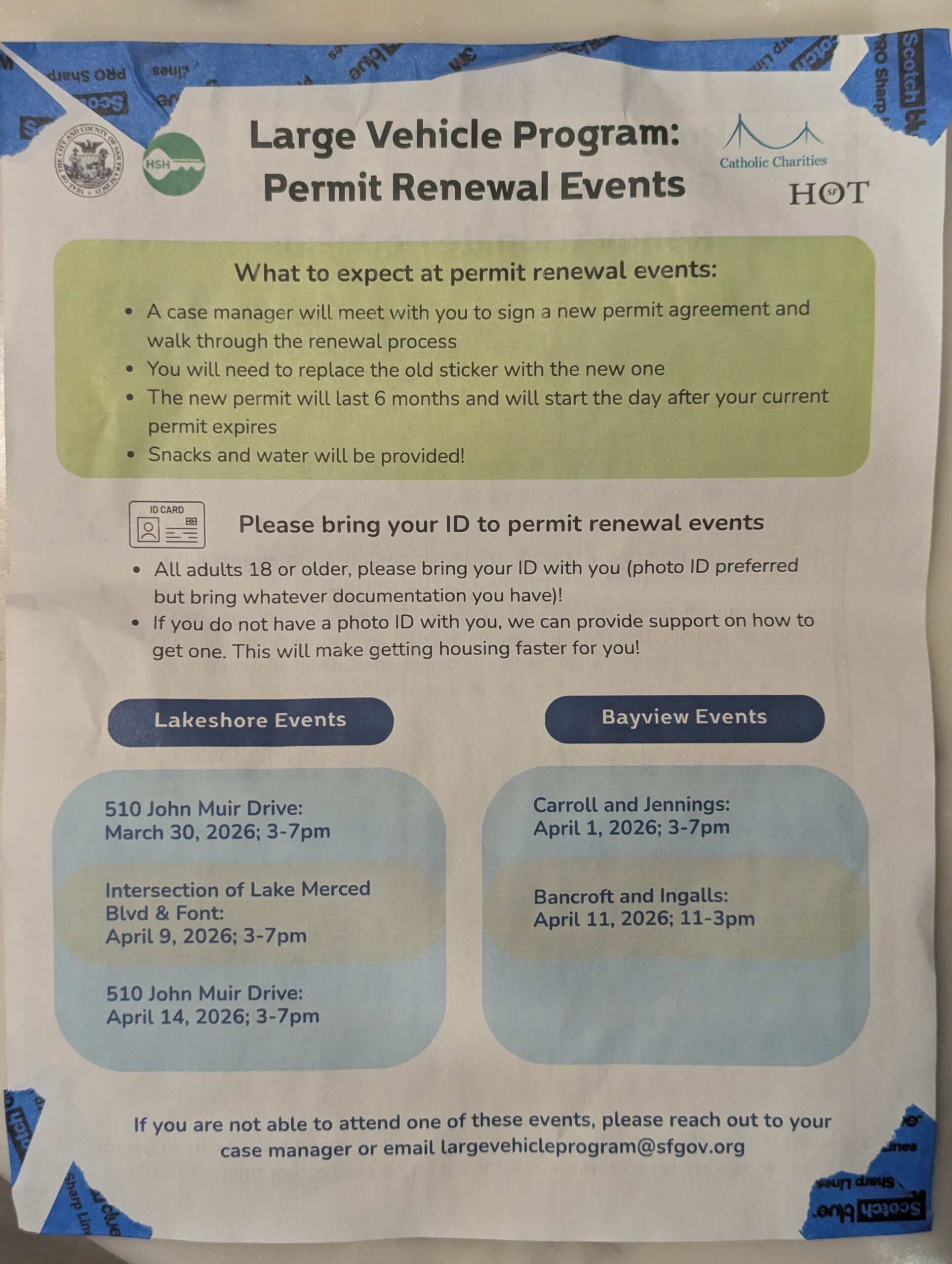
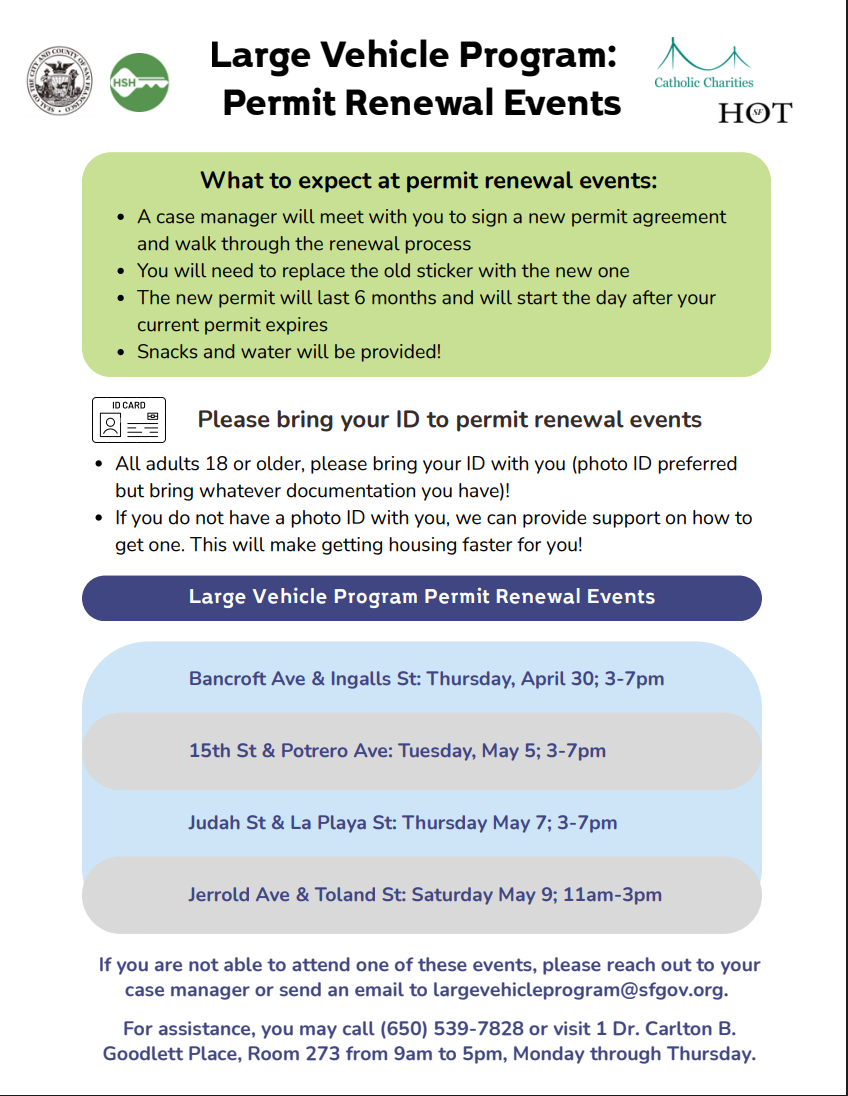
According to an email from the Department of Emergency Management, the added renewal sessions are scheduled for: April 30 at Bancroft Avenue and Ingalls Street, 3 to 7 p.m.; May 5 at 15th Street and Potrero Avenue, 3 to 7 p.m.; May 7 at Judah and La Playa streets, 3 to 7 p.m.; and May 9 at Jerrold Avenue and Toland Street, 11 a.m. to 3 p.m.
This, combined with their robust outreach approach should get the remaining 17% of RV residents renewed LVRP permits. A big thank you to everyone involved who voiced their needs, opinions, and solidarity to help get this moving forward in a positive and restorative manner, and a big thank you to DEM for doing right by unhoused people living in their RVs!
ORIGINAL STORY BELOW
Four out of 10 San Francisco RV residents are at risk of losing their homes when their six-month parking permits lapse on April 30.
Of the 225 RVers who still need to renew their Large Vehicle Refuge Permit, 88 have yet to renew as of April 14, the final scheduled in-person renewal session on the City’s schedule. This is just the latest example of a pattern of a hastily implemented plan, according to residents and advocates.
First, a bit of background. In October 2025, the City began permitting qualified RVs which would exempt them from the new two-hour parking limit on vehicles taller than 7 feet or longer than 22 feet. The permit also enrolled RV residents into a program that would work to find them housing, work with them on financial stabilization, including forgiving debt to the city, and to find work. As of April 24, 2026, 114 vehicular households were connected to housing or shelter,
In order to qualify for the new permit, RVers had to prove they were present in San Francisco prior to a City-made count during the last week of May 2025. This police-led count showed some 500 RVs parked in the City. If an RVer was among these 500 counted, they did not have to present much documentation: just an ID and proof of insurance, registration card, or title or something else which showed they were attached to the counted RV or trailer. Fortunately for myself, an RVer, I was already in the count and getting my permit was quick and easy. This was not necessarily so easy for those who were not included in the count.
If they were NOT in the count, they could appeal and had to show the aforementioned documentation as well as prove that they were in San Francisco prior to the end of May 2025. For example, an up-to-date registration beginning in December 2024 at a San Francisco address would satisfy this requirement. Also, the RVer could provide parking tickets, tow receipts or mechanic receipts as proof of San Francisco residency pre-May 2025. Other kinds of proof of residency were accepted on a case-by-case basis, subject to review.
Unfortunately, RVers who should have qualified for a permit were denied for having inadmissible proof—for example, a child’s attendance in the San Francisco Unified School District did not qualify. Then, halfway through this process, the City changed the rules and constricted its requirements to proof of residency to only between January 2025 and May 2025, instead of any time prior to May 2025. When this happened, some RVers whose permits would have been approved in the first half of October were denied in the latter half of the month. For example, an RVer who got parking tickets before January 2025, but not since, would have been approved in the first half of October, but denied in the second half of the month.
Of the 500 RVers that the City counted, 216 got their permit right away. Of the 126 RVers who were initially denied but filed an appeal, 111 were granted a permit. While it’s generous for the City to issue permits to such a high number of RVers who weren’t in the count, it reveals that it did a poor job of counting RVs—it’s not hard to miss well over 100 large vehicles! During this time, many volunteers worked to inform RVers of the new law and permit program—largely because less than half of those counted received a permit and since many people were completely uninformed about the law and program even as the program was in action. In several cases, it wasn’t until volunteers reached out to them, even on the same day as the permitting session was taking place right around the corner from their parking space. All of this gives off the stink that the City is subtly trying to squeeze or scare poor people in precarious living situations out of San Francisco.
While the program’s initial rollout was rocky, to say the least, RVers expected some future reassurance of a clear process and clear communication from the City. However, post-permitting, RVers continued experiencing problems with the LVRP program, now in their dealings with case workers—usually by either being coercive or non-responsive. Lack of response from case workers caused anxiety in people who were already anxious to access housing. RVers worried over losing their permits simply because their cas workers hadn’t contacted them yet. Further, this lack of responsiveness caused worry that they would lose their permit for lack of contact, which, in this case, was not their fault!
A few RVers who were unpermitted were approached by City workers with the threat of, “Buy this permit from me for hundreds of dollars, or else face a tow.” Some also endured the horror of their permitted RVs being towed because of lack of current vehicle registration, resulting in these people falling into street homelessness.
For RVers who had not, or who had not yet, experienced these problems, but witnessed or heard of these goings-on, anxieties began to mount. Among other concerns, they began asking when and how they would renew their permit only three months into the original six month permit period.
Many RVers and homeless organizations expected renewals to be automatic, given the words of supervisors at public meetings, but that did not turn out to be the case. A mere three weeks before the original permit period ended, PDFs mysteriously appeared on the Department of Emergency Management’s website that all but confirmed that repermitting must be done in person. RVers began to wonder if they would still be able to qualify for a renewal. Given issues in the original permitting period, homeless advocates wondered if all permitted RVers would be able to get their renewal and continue to stave off the risk of the City towing their homes.
The list, locations and times of pop up meetings at various sites for the repermitting process was not made to RVers until the week before, and only to a small group on one street. The game this time was that the city was holding a total of five in-person repermitting table sessions over a two-week period—half the number as before over the same amount of time. At least this time, the only documentation required was an ID. Otherwise, the RVer’s case worker—or a new case worker, if the RVer had not been assigned one—would reach out to the RVer to schedule a time and date to replace their original permit. Or if no case worker reached out to an RVer, they could email the program. This email mode was highly suspect, because of a lack of email response during the original process.
For several people, it wasn’t until April’s meeting of the Homeless Oversight Commission —after the repermitting process began—to address the late notification and unresponsiveness to RVers emails that the City finally began improvements. Too little, too late? While it’s nice that City agencies can sometimes respond positively to poor performance, reactive adjustments continue to signal that the needs of RVers are not being proactively addressed by advance criticisms from homelessness organizations and, more importantly, homeless people themselves. AGAIN, to compensate for lack of city efforts, volunteers had to show up to help RVers stay informed of the permit renewal process, sessions, and deadline.
As of this writing, the program outcomes dashboard of the Department of Emergency Management shows that 135 large vehicles have been towed that were not part of the City’s RV buyback program. Now, with only one week before the renewal period ends, it is still considering having one, maybe two, more table events to help renew the permits of the remaining 88 out of 225 RVs. Let’s see if they can make good by RVers on this problem and prevent even more people losing their homes. Better yet why not have an office folks can go to get a permit. Fingers crossed!