
Street Speak is a podcast of Street Sheet. The following excerpt is from Episode 22, a conversation between Jennifer Friedenbach, executive director of the Coalition on Homelessness, the San Francisco-based homeless advocacy organization that produces the podcast, and Anya Worley-Ziegmann, coalition coordinator of the People’s Budget Coalition. To listen to the entire interview, go to streetsheet.org/street-speak-podcast or the platform where you listen to podcasts.
This interview is edited for brevity and clarity.
Jennifer Friedenbach
Today, we are talking about the San Francisco city budget. Holy crap! So, you know, we have this big looming shortfall in money, which I think is a little bit of, you know, sometimes a bit manufactured, because they always underestimate revenue. And at the same time, there is some realness to it and you know, and the fact is that a lot of the community is very worried, because, you know, folks are getting hit from all sides, the federal, the state and the local government. So specifically, we’re talking about a group that is taking on the city budgeting priorities and trying to make them prioritize, you know, folks that are vulnerable, folks that are impacted the most when bad decisions are made around poverty. And so it’s called the People’s Budget Coalition. And the People’s Budget is blessed to have a super awesome, amazing staff person, Anya Worley- Zeigmann, and maybe you can just start off by telling us a little bit about yourself and how you came to the work?
Anya Worley-Ziegmann
I’m Anya Worley-Zeigmann, I’m with the people’s budget coalition. I’m the coalition coordinator, and the people’s budget is a big coalition of about 150 member organizations who are a lot of community-based organizations, some who do direct services, some who help people organize, and, overall, people who try to meet the needs. And we also have regular San Franciscans and advocates alongside us who really care about this, and know how important the budget is, and for myself, this will be my seventh or eighth budget season. So one, I’ve been in budgeting since I was an intern with (Supervisor) Dean Preston’s office in 2020, being my very first budget. And so it was all on Zoom, but that’s really how I learned some of the inequities here, and really got to watch them. And then I was Hillary Ronen’s budget fellow when she was Budget Chair, and that’s really how I saw the inside of this. I was really radicalized by that process of being the one in the spreadsheets, having to reduce funding for community orgs myself because they wouldn’t budge on the police budget. And so I kind of saw the inside of those negotiations, and ever since then, I’ve been working on the budget and I am very fascinated and interested in this. It is deeply inequitable, and I want to be able to do something about it.
Jennifer Friedenbach
It’s like Martin Luther King said, the budget is a moral document, and so maybe you could break it down a little further for us. What’s happening with the SF budget? I mentioned a deficit, but who seems to be getting money and who isn’t at this point in time.
Anya Worley-Ziegmann
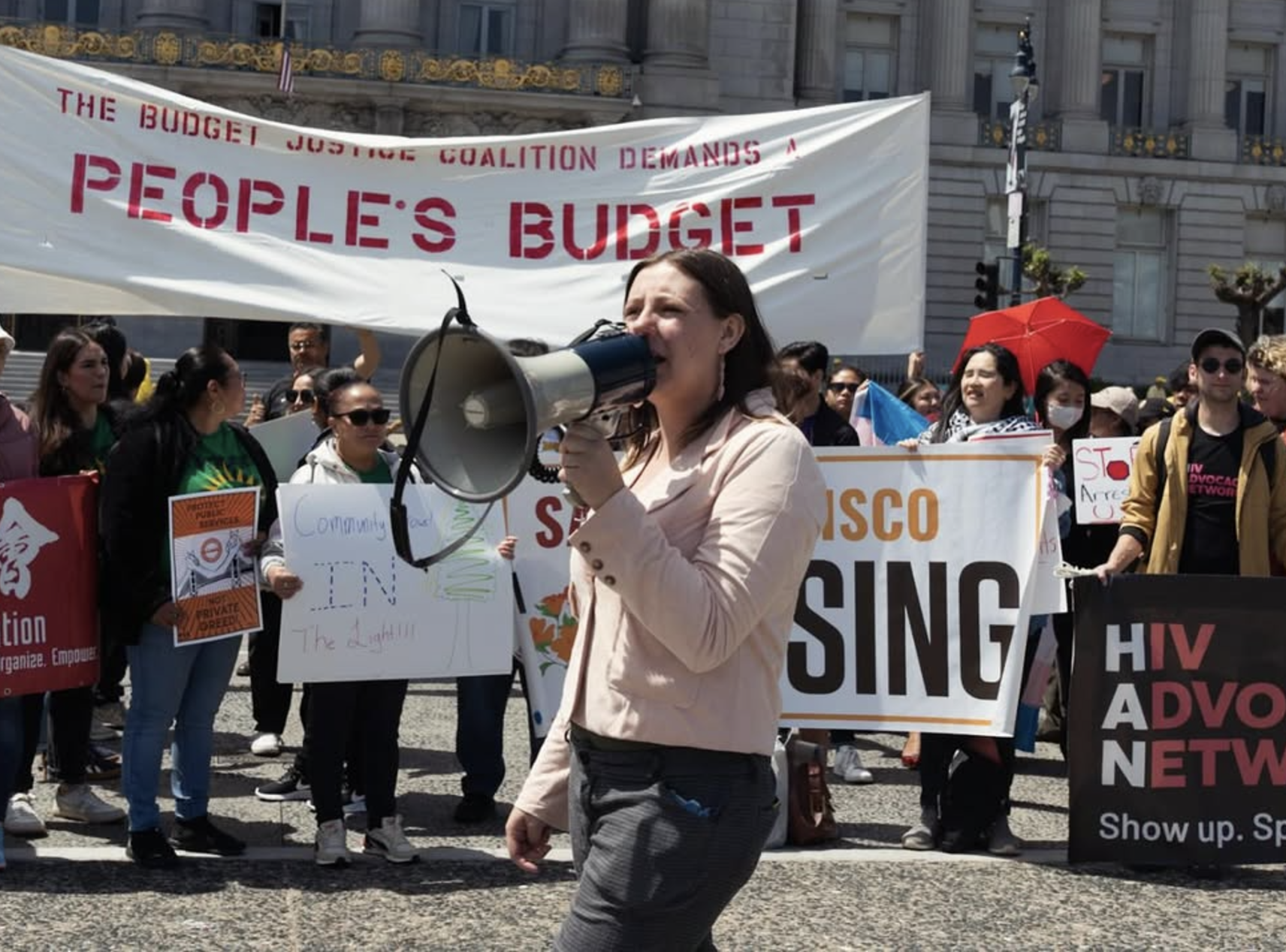
You’re so spot on with some of the deficit being real, and some of this kind of being a little bit overblown, because that’s a real part of this. Overall, we’re facing about a billion-dollar deficit over the next couple of years, and those projections are made by the City Controller and the City Economist, who sort of look at our economy and see how it’s recovering. They always assume that the deficit is going to be worse than it actually turns out to be. So to some extent, it is an overprojection, but when our legislators and our lawmakers treat it as a firm reality, which is what we’re saying with (Mayor Daniel) Lurie, is that he is assuming we are not going to raise revenue, and he is opposing the Overpaid CEO Tax [Proposition D on the June ballot] in order to start some of those revenue raising. So he’s indicating “screw whatever the deficit is going to be, or what it could be in the future, we are going to make a billion dollars in cuts over the next few years.” So that really makes the deficit real.
Jennifer Friedenbach
So that’s some DOGE style stuff right there. And also just want to add in, not only is he not supporting new revenue, but he is already cutting revenue with the [Prop. I] real estate transfer tax cutting that in half, which basically the money is supposed to go to affordable housing. The ironic part is, it’s a tax break for large landowners that are buying buildings. So pretty disappointing.
Anya Worley-Ziegmann
Yeah, it’s gonna be a huge hit to our budget. It’s unbelievable that [Supervisor Bilal] Mahmood is also supporting this when he supports the Overpaid CEO tax, it’s hard to even justify. How can we do a tax break in a moment like this? Like, if you want to redo the taxes, not now, we cannot balance it on the backs of the most vulnerable.
Jennifer Friedenbach
So how does that situation with the budget fit in with the People’s Budget Coalition, in terms of your mission and your goals?
Anya Worley-Ziegmann
That quote that you mentioned from Martin Luther King, Jr., that is really our defining quote as a coalition is that budgets are moral documents. That is the No. 1 thing that we believe is the People’s Budget, is that knowing that budgets should reflect our values as a city. So not only should they represent like the bread and butter of what it means to have a democratic government, but it also needs to represent what San Francisco believes in. So we can’t view these services that we do as optional, because we’re willing to take the bet that San Francisco believes in LGBTQ services and HIV care, and in a lot of these services that are proposing to get cut. So we come at it from that angle, letting San Francisco know this is what’s happening with the budget. We’re the only organization that tries to make the City budget understandable for people. We’re still the only one that tracks community budget impacts. Let people know this is what’s happening. This is what is happening in your budget, and it’s yours, and you have the power to change it. And we want to join with people and say “Change with us, we want to see your values represented in this budget.”
Jennifer Friedenbach
I know on the daily that you are getting deep into the weeds of the City budget, but maybe you can explain to listeners just kind of like some key aspects of the budget, kind of a quick 101, so our listeners can understand how the budget works here in San Francisco, so that they could affect change within that?
Anya Worley-Ziegmann
We get very in the weeds on the budget. There’s a lot to understand, and I like to let people know as they come into the budget fight that it’s confusing because it’s supposed to be, it’s designed to confuse you and overwhelm you, so that you feel like you can’t make a difference and you back out.
So we always encourage people, “if you feel that feeling, you’re supposed to feel like that. It’s set up so that you feel like that.” So getting over this together, getting through this, trying to figure it out together, is a long history of budget advocacy in the City, so some of the things that you can really cling to, no matter what else you find out about the budget, is there are some big core facts that are true, and one that’s super essential to San Francisco.
Many of us might not come from San Francisco and might have experience with a different form of city government, or even being paying more attention to the federal government, and it’s a little bit different in San Francisco, because the mayor has the final say on the budget in a way that the President does not have the final say on the budget, and the way that some other cities don’t necessarily operate. But in our strong-mayor city, Mayor Daniel Lurie has what we call “line item spending authority,” so he has the last call on how every dollar is spent. So the Board of Supervisors is really important, but how they’re important is through negotiating, and not always through their own legislative power, because they can make decisions on the budget, but the mayor has to agree to those decisions. So we’re in a negotiation where one side genuinely has all of the power, but one side can generate more power to the people. And so that’s kind of how we flex the levers of this system by demonstrating consequences for legislators who don’t act with equity, moving people power and saying, “This is what our priorities are. You need to be in step with the people of San Francisco.”
Jennifer Friedenbach
Because the legislative branch basically gets a budget from the mayor. They can do some cuts to it, and that gives them a little bit of money to put back into the budget, but then the mayor can still choose not to spend it. Also, the mayor could choose to veto the budget. It’s just like an ordinance, or [the Supervisors] could override him with the supermajority, but still, then the mayor could choose not to spend those items. And the mayor can also make mid-year cuts. So we’ve seen in years where cuts were restored, and then the mayor just knocked them out in the middle of the year. So, yeah, a very strong mayor system in San Francisco. So maybe you can kind of give us a little color on the canvas we’re painting here, and talk a little bit about some of the organizations that are part of people’s budget and what communities they’re serving and what funding threats they’re facing?
Anya Worley-Ziegmann
Another really interesting fact about San Francisco’s budget is that a lot of the core safety net in San Francisco is done by community-based organizations. So it’s done by nonprofits who are based in the neighborhoods, who are often small, who serve communities that the City can’t reach, that’s kind of unique to San Francisco. And so for some cities and counties that might be, “oh, if we have some extra money, we’ll give it to a nonprofit.” That’s not really what we do here. We contract out really essential parts of our safety net. So these are not additive things, and so it’s a unique part of San Francisco that means that a lot of our budget organizing is also really centered on these community-based organizations who are doing the work on the streets, who are both serving the people who need their help and are also made up of the community that they help. As many of the nonprofit workers are low-wage workers of color, who are also in the same situation as their neighbors. And so some of those people that were so honored to partner with are, like HOMEY out in the mission. La Raza Community Resource Center, if you’re in the mission in Excelsior, we work with Excelsior Works. Chinatown, we have Chinatown Community Development Center and the Asian Women’s Shelter. There’s a lot of these different organizations. And down in SoMa, we have SF Rising and Bishop and SoMa Community Action Network (SOMCAN), these are some of our key orgs, but also it’s a lot of queer-serving orgs, like the SF AIDS Foundation, a lot of community groups who don’t even receive City funding as well. So a lot of senior advocates who aren’t on the City’s dime and can be a little bit more proactive about what they share all of these different orgs coming together to say we really believe in something different for our city. We see what’s happening on the streets day to day, same thing that City workers experience as well as you see the issue up front, and you get that feeling that like this is a broken system and it needs to change, and all of us being aligned on the budget is the way that we change a lot of these things. Policy is great, but policy really matters when there’s money behind it.
Jennifer Friedenbach
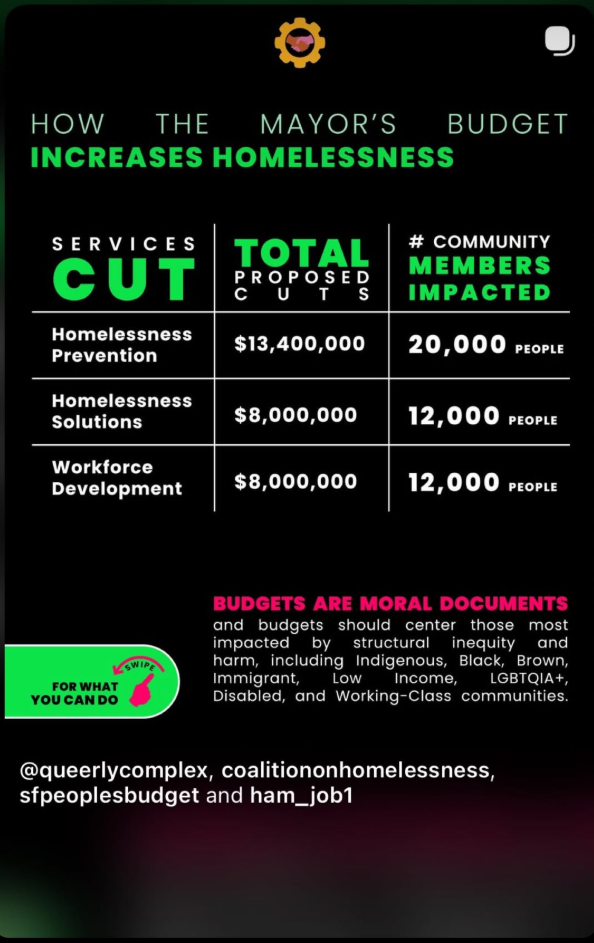
I just want to add in here, there’s something very strange happening this year in that we’re seeing commissions that are supposed to be independent bodies, and they’re passing cuts without identifying what they are. So, the Homeless Department has $4 million in cuts, but we don’t have a detail of what those are going to look like, and we may not even know all the way until the mayor releases his budget, because basically, they’re saying the mayor is going to decide the cuts we have. Department of Public Health, same thing. They already did $17 million, and they had a fairly transparent process on that, and they had to make some corrections based on the kind of the guidelines that they put out about what they’re going to cut or not. Cut or not, because they made some mistakes, which is natural, but now they announced, all of a sudden, $40 million more in cuts: $20 million from civil service, was what they first said, and $20 million from CBOs. Now it’s $25 million from CBOs. So, we don’t know what those are going to look like, but we can guess based on when (Gavin) Newsom was in charge in the Great Recession. DPH had $40 million in direct service cuts, and they basically go after the stuff that is only funded with City money. Because if it some of the stuff is like a match.And so if you spend, you know, $10 million on this, the state matches you 10, so they don’t want to cut that 10 because then they lose $20 million, so they basically look at those, those those pots that are 100% city funding, which tend to be the folks that get totally left out. I mean, if you look at the mayor’s office on housing and community development funds, I mean, you know, transgender community at this time during Trump just getting absolutely slaughtered. We see, you know, just, you know, violence prevention programs getting slaughtered, then we see an increase what we saw this year. The rates of violence are going up as a result. So these have real consequences. I was around in Newsom when he did $40 million to public health cuts, it was all behavioral health. And guess what? We started seeing critical incidents that we hadn’t seen before. The rates went up. Just crazy. Rates went up of critical incidents in our shelters and in our drop in centers. After that funding was cut, I still run into folks today that lost something back in those years. You know, back in 2007 said my life hasn’t been the same since I lost that day treatment program for my behavioral health. And so it really, they really hit hard. So we’re really nervous about that. And you know, we’re going to see more about that. And I know we’re going to circle back around to some specific big dates coming up for folks to turn out to. But maybe we could talk a little bit about the current political environment. We have a very conservative Board of Supervisors. We have a very conservative mayor, that’s a lot of alignment between Trump policies and our local policymakers in terms of increasing the number of people being locked up and expanding detention centers.
These are things that we’re really concerned about. But given this political climate, what are some of the biggest challenges we face during the budget season and negotiations, and how are we going to tackle that?
Anya Worley-Ziegmann
The first thing that it feels like that we face is attention is like flooding the zone that Trump is doing is really real, and so that’s a big part of what he’s doing is grabbing all of the headlines. We’re in a constant state of emergency, and so the same people responding to ice incidents are also having their budgets cut. So the same people responding to health care cuts are the same people who are having their budget cuts in San Francisco, and honestly, the City is taking advantage of that in order to say people are paying attention. Let’s really quickly see how we can replicate what’s happening federally with what’s happened locally. Let’s see if we can get people to be a little bit distracted. So that’s a big part of this, is that working class people are under the biggest threat that we ever have been, and we’re facing a historic deficit in San Francisco. This is one of the biggest things in the moment, and our legislators know that locally, and that’s why they are doing that, that’s why they’re doing it right now, is because they sort of want to take the bet that people aren’t paying attention. I do not think that’s true. Of course. I think people are going to absolutely start to pay attention, because these are really devastating. I think that they’ve sort of, you know, miscalculated on where the power of the people is. At the same time that we’re seeing all of this emergency situation, we’re also seeing working class people organize and stand up and say, sort of wake up a little bit and say, This is our city. This is our country. We do want something different, and maybe we can’t necessarily fix what’s happening at the federal level. We can fix San Francisco. We have the power to fix that. And so that’s a really big challenge that we face on attention and on working class people, but it can also be a really big strength, because it’s activating working people. But another big challenge here is this really conservative board and this really conservative mayor, when they’re really in lockstep like this, it locks the community out of the process. It means that the people who got them into office, who funded their campaigns, their budget priorities, are going to be represented in this budget. That’s the instructions that departments are getting. That is what they’re hearing. We’re not at the table making these decisions with them. Is that we’re locked out of this. Our best ways are to go around them, let the people know, nobody else is going to tell you, this is what’s up with the budget. This is how you can make a difference and to know and let people know you can make a difference if they are responsive to people power when we demonstrate it. So it’s a challenge we’re absolutely going to have to navigate. It’s the Board, it’s the mayor who makes the final call, but it’s the Board, much like Congress just sitting back and doing nothing as Trump devastates the country. The board is doing a very similar thing. They’re just sitting back, letting the mayor make all of these really devastating cuts.
Jennifer Friedenbach
I agree. We can turn this around, absolutely. But maybe you give some examples of successes, some wins. We were in the same position last year. So any examples of some big wins?
Anya Worley-Ziegmann
Yeah, and I think there’s a sort of an overarching hopefulness that’s on the rise here of parts of parts of this kind of come back to the commissions as well as some of these commissions are getting really gutted through this process, but it was really great to see in the last election cycle, it was on the ballot this really conservative measure to say, let’s just willy nilly get rid of all of them. And the voters said “no,” like time and time again. The voters say, we want to tax the rich. We want more homeless services. We want more services, more safety net things. So the voters, when they have the chance, will stand up for San Francisco values. And so that’s one thing that really drives us, is like we know that the voters are often on our side. And then when it comes to the budget fight, and how that really helps us is that no matter how complicated and in the weeds the budget fight is, we’ve seen organizing able to turn these decisions around.
And so one that happened a couple of years ago was a program called ERAP. So there were cuts to the Emergency Rental Assistance Program a couple of years ago in people’s budget. That was one of our first years organizing here, and it’s sort of this in the weeds program that hadn’t existed for very long, necessarily, and many people didn’t necessarily know about it, but it was cut. And so we face that moment when the odds are set against us. People don’t know what this program is. It’s going to be really hard to understand these cuts and why they happened. The mayor’s office is putting out their own narrative about what’s going on here. And it was turned around. And we organized in a really big way. We educated the lawmakers, and to say, This is what the program is. This is why it’s important for people who are going to be impacted in a big way. And it was reversed. And not only was it reversed, which was a very hopeful and a big, optimistic, triumphant win, it hasn’t been touched since then. We made a really big stand in one year, and they learned their lesson on Don’t touch this program. And code enforcement is another one.
There’s this code enforcement program that if your landlord is screwing you over and your ceiling falls in on you, they can help you. They can speak the language, they can reach you. And these are some of the nonprofits who are in the People’s Budget, and they fought it again. They fought it for the past couple of years when there have been cuts to their program. They fought it back.
Finally, we’re hearing that there’s not going to be cuts to that program, and sometimes it takes a while. But what we really see is that when you fight big for something, when you come out and you say, you make a statement, this is a part of San Francisco values. San Francisco values this program. We have its back. They tend to learn the lesson. They tend to scurry back, go back to the drawing board, and they’ll hit you in a new spot, but they will remember the lesson they learned. The people care about these things.
Jennifer Friedenbach
I mean that means, because that program got restored, thousands of households were able to stay in their homes that had a medical emergency, or they lost their job and they couldn’t pay the rent. But, you know, think about it. You lose your place in San Francisco, you are screwed, and the landlords want you out so they can jack up the rent. Because as soon as the tenants are out, they don’t have to follow rent control. They can bring that rent up as high as they want. So there’s a huge motivation for landlords to put people out, like, you mean, like, $10 short on your rent, and they’re like, “bye!” Not all landlords, but, you know, the big corporate ones that are really all about the money and not about the community. So this is really, this was really important.
And, you know, in the same with Yeah, like, yeah, that it just, it’s, it’s really about having a healthy and thriving San Francisco and keeping people safe. Like, that’s what community safety looks like. It looks like having a home. So this year, how is the People’s Budget planning on fighting back? How are we going to get a just and equitable budget for the people of San Francisco?
Anya Worley-Ziegmann
I’m really optimistic about this year. I’m feeling optimism in a way that I haven’t felt in past budget cycles. Because what we are hearing is that not only are the organizations who do these services, they are ready to respond like they are ready. They are aware. They are active. They are getting organized with us. So not only is our core base of people getting aware, it is spreading to our neighbors. You’re starting to hear this talk on the street of “ooh, I know the budget is bad.” I heard that there’s going to be a lot of budget cuts. It’s starting to get out there. And these narratives that they’re trying to push on us, they can’t hold for very long, is that we know, like “you’re not going to be able to convince San Francisco that we have to make these budget cuts, but we also can’t tax the rich.” That is just that lie is really getting exposed in a moment like this, for we see a way through this of letting people know this is the situation we need to maintain this budget. Not only that, we have to continue our economic recovery like we cannot afford to stop all of these programs that keep people housed. We cannot afford to push a bunch of people into homelessness.
We need to use some of these temporary measures to keep these things in place while we raise taxes on those of us who are doing just fine in this economy. The Dow is doing great. There’s an AI boom like these things. The economy itself is having these two different worlds where working people are struggling and the rich are doing great. We need to tap into some of that, the people who are doing great. So how People’s Budget is responding this year is to let people know there is a way out of this, and it’s not going to be easy, for sure, but what we can do to fight back this year is keep these programs, fight back in order to win back a lot of these essential programs that are otherwise going to go away. Then we’re going to hit the ballot box, and we’re going to say “San Francisco, help us raise some revenue here. Help us solve this in the long term because their long term solution is to make these cuts.” That’s not our long term solution, right? That’s our strategy for this year.
Jennifer Friedenbach
It makes cuts to impact the poorest people, while increasing funding for things that harm folks. And so, you know, that’s the whole thing about this budget deficit. It’s so frustrating that, you know, we’re in a deficit. They’re proposing all these cuts, and then they like to spend money like drunken sailors. I mean, they’ve opened up a new jail now they’re opening up a new detention center that is the silliest idea ever, and $14.7 million to hold people for four hours who are taken in on public intoxication or public drug use that they’re, you know, then gonna, if they, you know, leave, they arrest them, and they bring them over to the jail. The jail. And the big advantage is the police don’t have to do paperwork and all this stuff. But at the end of the day, what people need is what gets cut. And so, you know, we’ll see what happens with these public health cuts. But the way that it’s laid out, I’m just going to guess that there’s going to be some of the best programs in San Francisco that are actually addressing people’s needs that have substance use disorders, programs that are getting them access to ongoing therapy, that they’re able to address their substance use disorder with, and able to address the underlying trauma and other underlying mental health conditions that are driving that addiction while, you know, bumping up these kind of performative, expensive, what looks good in a press release, but in reality is just doesn’t work at all. And so, you know, I think these are the things that we have choices to spend on or not spend on. And I think, you know, nobody, nobody from people’s budget, is saying there’s nowhere to cut in the budget. That’s not true. There’s plenty of places to cut in the budget. There’s things that are wasteful, there’s things that are graft, there’s things that are doing harm, and we also identify those things. So, you know, do we still need a mounted unit for SFPD? Do we still need it, you know? I mean, there’s, there’s a, there’s a variety of different things and positions that are basically like political, you know, these, these different kinds of, you know, I volunteered for the mayor’s campaign, so now I get a little, you know, plus a $150,000 job. So there’s plenty of areas in the budget that can be cut. But what we don’t want to see cut are the things that are vital for San Franciscans, that are already struggling to survive, that are already having affordability issues. A lot of our workforce is being cut. A lot of things are changing economically. People need to be retrained. They need to be able to have access. There’s communities that are historically outside of jobs that haven’t been able to access, jobs as you know, as things have changed over time. you have people who are doing grading construction, and then have a back injury and need another form of income, or else they’re going to fall down and end up out on our streets. And that’s, that’s a lot of times who we’re looking at out there. So these are choices, you know, these moral choices that we keep talking about. So maybe we can talk a little bit here towards the end of our program about how folks can get involved with the people’s budget, how they can take action on any upcoming events that folks can plug into. And that would be great.
Anya Worley-Ziegmann
That’s all so true is this is a moral decision, and we need to hear from people like, where your morals lie. And we need to hear that from San Francisco, like, what are your priorities? Because whatever the issue is that is core to your heart, people’s budget wants to help you work on that. Like you care about domestic violence, there’s cuts to that. You care about immigrants, there’s cuts to that. And all of these different areas really need your support. And we’re always happy to plug people in.
So the beautiful part of the budget is that you get to see results just like that. You get to see them on July 1, real lives are impacted and saved by the work that we do here. And people have a way to get involved and we welcome that we have a lot of organizations in our midst, but we also have a lot of individuals who are just passionate, who only have, like, a couple hours a week to help us out. So they’ll help us make a flyer, contribute their heart to this program, to this work. They’ll help and come out and give testimony for their senior organizing program that helped them stay housed. There are so many ways to get involved, and we welcome all of them, and want to connect with you as advocates and as individuals, everybody has a place in this budget cycle, from wherever. Organizing the home you come from, from wherever. Issue the budget touches it all, and the budget has a place to say about all of these things we want to meet with you. Tell you how to navigate this be your home base for budget organizing.
To learn more about the People’s Budget Coalition, get involved or receive updates, go to peoplesbudgetcoalition.org.