
by Kidest Yigezu
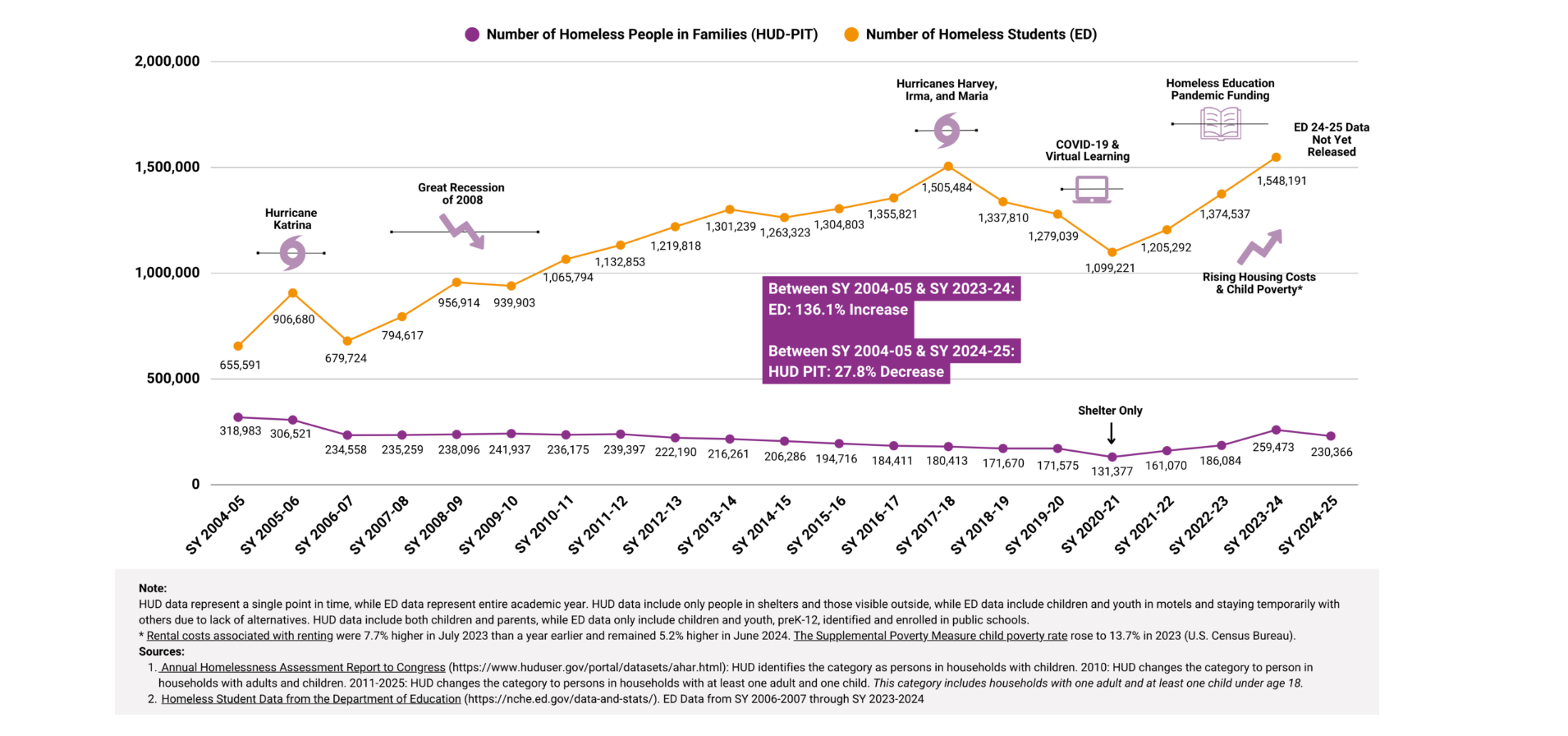
In late August, the Washington, D.C.-based advocacy organization Housing Up released an article that highlighted the hidden homelessness in our K-12 education system. Under the McKinney-Vento Act, the U.S. Department of Housing and Urban Development (HUD) defines a student experiencing homelessness “as one who lacks a fixed, regular, and adequate nighttime residence.”
But a significant part of the issue is the huge discrepancy in the representation of homeless students in national datasets like the the point-in-time count that happens every other year on a single night in January and focuses on visible homelessness, such as shelters and street homelessness. Policymakers, media, homeless-serving organizations and politicians across the board often use the data to assess the unhoused population in an area and create and support policies related to homeless issues.
However, these counts often miss students who are often in situations where they are couch surfing, living with relatives or staying in vehicles and generally more hidden for fear of separation from family, among other reasons. As a result, schools and daycare centers—often the first point of contact for students—define homelessness more expansively.
HUD data from 2003 to 2025 shows an 18.7% decrease in families facing homelessness. But when you look at data from public schools from the same time period, their numbers tell a much different story— a 136.2% increase in families facing homelessness.
Although schools have a responsibility to record the number of homeless students enrolled and report these figures to Congress, they’re not always up to date. Housing Up reports “…this process often takes years due to delayed reporting, bureaucratic inefficiency, and overburdened school systems.” As a result, when policies are created to address homelessness, students are again underrepresented and the issue remains unaddressed.
Homelessness does not just affect students’ home life, it also has compounding negative effects on their education. For many low-income students, higher education is one of the few paths available to exiting poverty and the lack of stable housing is detrimental. A study done by the National Center for Homeschool Education found that moving frequently is associated with chronic absenteeism—defined as missing 10% of the school year or more than 18 days in a 180 day school year—and causes a significant disruption to learning. Public schools reported that 48 percent of students experiencing homelessness nationwide were chronically absent. As many schools have attendance minimums, this greatly impacts a student’s ability to graduate high school, as well as preparing for college and careers that further economic mobility.