by Eliza Macaluso and Kalevi Kaukonen
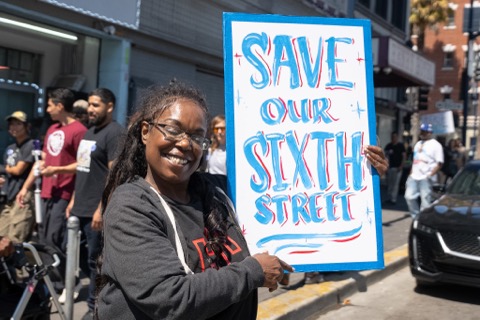
Mayor Daniel Lurie’s administration has terminated its contract with the Sixth Street Self-Help Center, forcing the Center to close by December 31, 2026. The closure comes as City leaders attempt to “revitalize” the Sixth Street corridor.
Hospitality House, a nonprofit that has served San Francisco’s housed and unhoused residents since 1967, operates the Sixth Street Self-Help Center and six other programs. Nearly 20 years ago, the San Francisco Department of Public Health asked the Hospitality House to open a location in the South of Market neighborhood to replicate the successful model of their Tenderloin Self-Help Center.
Since the Sixth Street Self-Help Center’s opening, it has provided mental health and substance use counseling, crisis management, and connections to services for rental assistance, disability assistance, and housing to anyone in need—housed or unhoused. Annually, over 4,200 people utilize the harm reduction and health services that the Center provides. These services have successfully offered lower-income people tangible resources to meet essential health and safety needs.
In addition to essential services, the Center also provides internet access, a mailing address, and message-taking—all measures necessary to schedule appointments for housing placement to prevent recurrent homelessness.
Lurie’s administration is reallocating the budget and services to the Tenderloin Self-Help Center, at 146 Leavenworth St, also operated by the Hospitality House.
When Mission Local questioned about the termination, Lurie’s press office issued a statement saying, “We’re currently looking at how to activate the space at 169 Sixth Street and bring in resources and amenities that serve and energize the whole community.”
But to Joe Wilson, Hospitality House’s executive director, what the City calls “activation” is more akin to the demolition of neighborhoods under urban renewal policies in the mid- to late 20th century.
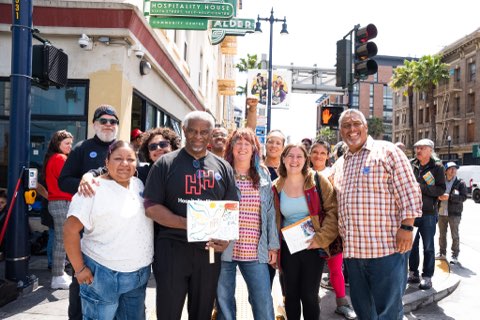
“What urban renewal is, is urban removal,” Wilson said, addressing a crowd at an August 19 rally in front of the center. “It’s replacing one class of people with another. That’s you, we say ‘no’ to that.”

Despite stated intent to serve the whole community, the removal of the center on Sixth Street leaves a vulnerable group without essential amenities.
“[The Center] helps to prevent people from falling into homelessness, a super critical role,” said Larisa Pedroncelli, chair of the Latino Task Force’s Street Needs Committee.
Pedroncelli pushed back on the narrative that the Center draws unhoused people to the area. “The Center actually helps prevent unhoused people on the street,” she said. “[Its removal] is not going to get rid of unhoused people. It’s just going to make these issues worse.”
“The Center’s drop-in services keep people from ending up on the sidewalks in the first place. It provides a place where people can rest, use the bathroom and be connected. What happens when those bathrooms and drop in areas disappear? There’s going to be worse conditions on the street,” Pedroncelli added.
The closure’s impact isn’t limited to those experiencing homelessness, Pedroncelli said. Residents in the neighborhood’s single-resident occupancy hotels are also at risk. “A lot of people may end up losing their housing because they don’t know their rights or where to seek rental assistance, disability assistance, or food assistance, especially for seniors,” said Pedroncelli.
The shutdown of the Sixth Street Self-Help Center is part of a larger pattern to “revitalize” the City by removing essential services for low-income and unhoused people. Echoing San Francisco’s history of urban removal policies that have displaced marginalized groups, the decision to terminate this contract mirrors the gentrification policies that have long determined who belongs and who does not. While the language has shifted towards “revitalization,” the ideas remain strikingly similar—removing lower-income people through inequitable budgeting and policy choices that disproportionately affects groups that have long experienced disinvestment.
The need for facilities like the Self-Help Center has only increased as income disparity and gentrification continues to change the landscape of the city, forcing many previously housed San Franciscans into homelessness. These centers are some of the only stable places for people to get the rest they need. In recent years, places serving the unhoused and low-income communities have been shut down: the Tenderloin Linkage Center, the Homeless Youth Alliance, a 280-bed, semi-congregate shelter at 711 Post St., and a 116-person non-congregate shelter at the Cova Hotel.