
by Jordan Wasilewski
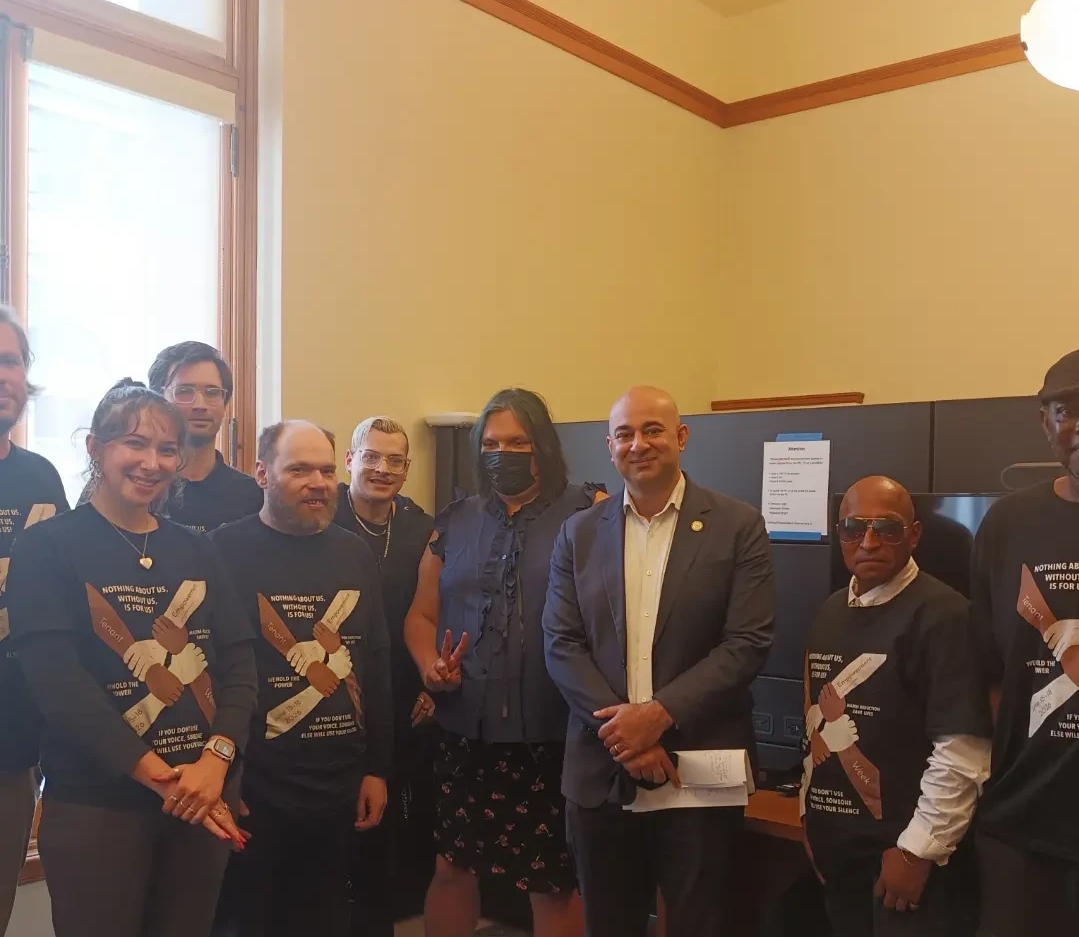
In June of this year, I participated in a Tenant Empowerment Week, which was organized by the Supportive Housing Providers Network (SHPN). I wrote about my first two days at the event last month, and continue here.
On Wednesday, Day 3, I once again got up early, put on some clothing that could be considered “gothic professional,” printed off the PSH Tenant Bill Of Rights Proposal, and then went to City Hall for another lobby day. First, we met with staffers from Supervisor Shamann Walton’s office—he was pulled into the Budget Committee, so he could not make it—whose district is not home to many permanent supportive housing sites. With Jackie Fielder on leave at the time, it felt like he was the only progressive left on the board, and the staffers who joined validated my feelings. To my delight, one of my fellow tenants brought up workforce development and how helping tenants who can work helps subsidize tenants who can’t. While many other permanent supportive housing tenants, including me, are steadfastly against work requirements for housing, we support anything that makes it easier for working tenants who are able secure employment, and we would support anything that removes barriers to working, such as higher income cut-offs for tenants and preferential hire. I pitched the idea of having a PSH advisory board, but it was shot down because of the whole hullaballoo about boards and commissions.
Next up was a meeting with my Supervisor Bilal Mahmood, who represents my district. I was really despondent over Dean Preston losing re-election to Mahmood in 2024, but if we can work collaboratively on some things that would help the thousands of PSH tenants who live in his district, I could live with that. We had similar conversations around workforce development, and discussed Matt Dorsey’s sober housing legislation. As I worked with Preston on PSH eviction issues, I gave Mahmood a one-pager on evictions based on HSH nonpayment of rent guidance and various conversations I had with tenants. I don’t remember his exact reactions, but I felt a faint glimmer of hope he might listen. Supervisor Mahmood, if you read this, the offer is still on the table.
Then, we met with Supervisor Myrna Melgar, who actually glazed me for working her campaign back in 2020. Although she has no PSH sites in her district and relatively few renters, she has said that she was willing to be an ally to PSH tenants, which I honestly think is mixed. When Dorsey’s sober housing legislation came to the board, she joined progressives in voting for Jackie Fielder’s amendments. But when those were shot down, Melgar still voted for the legislation anyway. I am still annoyed about it today. I suggested a couple of ideas such as reforming the collaboratives, about which Melgar and I had a text conversation when the San Francisco Chronicle’s “Broken Homes” exposé came out in 2022. We also discussed adding more scattered-site housing that would make PSH issues relevant to more districts, as well as making it easier to procure modular housing.
After breaking for lunch, a couple of other tenants and I went to a meeting of the Residents United Network (RUN) in Oakland. In hindsight, I wish I hadn’t, because while RUN’s work as a housing advocacy organization is important, it does not zoom in on the specific issues facing us tenants. However, one of the tenants who came was somebody who I’ve wanted to talk to for a long time. Back in 2023, this tenant spoke at public comment about how some tenants’ behavioral health issues have caused real harm to others; I spoke after him, and in hindsight, I wish that I had addressed how there needs to be a policy that addresses lease violations that balances public safety. Nevertheless, we had a productive conversation addressing these issues, and there were no hard feelings, so I guess it wasn’t a total waste.
On the fourth and final day, when all of us were already tired, we met with people from the Department of Public Health. DPH is a rather large department that covers a wide range of concerns, however, most of the staff specialize in behavioral health. Many tenants brought up gaps in addressing tenant decompensation. I brought up how DPH also oversees environmental health matters, such as hoarding and pest control. One hour later, we were done and headed to the Delivering Innovation in Supportive Housing office for a celebratory lunch. I chatted with tenants about our experiences and even had discussions with DISH executive director Lauren Hall about refrigerators and microwaves in permanent supportive housing. Because only a few of us actually went to meetings, we all won tickets to a Golden State Valkyries game—we were up in the nosebleed section, but we were all elated to see the Valkyries defeat the Atlanta Dream.
Tenant Empowerment Week was an enriching experience. At the same time, it also could have realized more potential. I really wish we could have met with Jackie Fielder’s staff, even though she was on mental health leave. Also, we would have benefited from meetings with other City agencies, such as DPH’s environmental division, the Department of Building Inspection, Human Rights Commission and Adult Protective Services, among others. The presence of other advocacy organizations, such as the Housing Rights Committee, Senior & Disability Action, Coalition On Homelessness and others would have also been helpful, so there could be some independent power building.
Which brings me to the issue of the pre-made talking points. I have had conversations with SHPN and DISH about how the pre-made talking points were part of a closed process and how more tenant voices should have been included. Although SHPN has a Resident Advisory Board, its meetings aren’t advertised to other tenants, and I’m not even sure if it has a public comment process. It is time for transparency in this regard, but also, I pitched the idea of a tenant convention to create a truly collaborative framework to create a vision, by us, for us. “Nothing about us, without us” was printed on the T-shirts at the beginning of the week, but those words must be put into action, and PSH tenants should say what needs to be said, not just what is popular.
Jordan Wasilewski (she/her) is a long-term permanent supportive housing and SRO tenant advocate, former commissioner, and affordability activist. You may follow her at @sfpshsro on Instagram.