
by Jordan Wasilewski
If you told me when I was a little and in the closet that I would eventually get a first-of-its-kind law passed that would help transgender and disabled people, I would have laughed in your face. However, that is what happened.
In 2015, I was placed into a permanent supportive housing SRO. I spent three months in a unit without a bathroom. Therefore, in order to bathe, I had to go to one of two bathtub rooms on my floor: and in order to use the toilet, I had to use one of two toilet rooms on my floor. Both had gender-specific signage, prompting me to begin a multi-month campaign to get gender-neutral signage—even after I got my own bathroom.
I faced resistance from some residents in monthly tenant meetings whenever I would raise the issue as I continued to grow in my role as a tenant organizer thanks to the Mission SRO Collaborative. In early 2016, the City and state considered laws that would require that all single-use restrooms in places of public accommodations be gender neutral. The City ordinance passed first, then the state law. By the beginning of 2017, all single-use restrooms in California were required to be gender neutral (Fun fact: when the City ordinance passed, I went all over the city and reported bathrooms that were out of compliance to the Department of Building Inspection, much to the annoyance of the inspectors).
But lawmakers left a glaring loophole that could only happen in San Francisco and other major California cities. Because much of our low-income housing stock is made up of SROs without private bathrooms, an entire class of single-use bathrooms was left out.
Tenants living in SROs designated as permanent supportive housing, including the Hartland Hotel where I lived at the time, were somewhat lucky in that many of the restrooms in SROs were made gender neutral by 2017. I was involved with Senior & Disability Action’s SRO Workgroup, where someone who was working in permanent supportive housing alerted me to this. However, private hotels apparently didn’t get the memo.
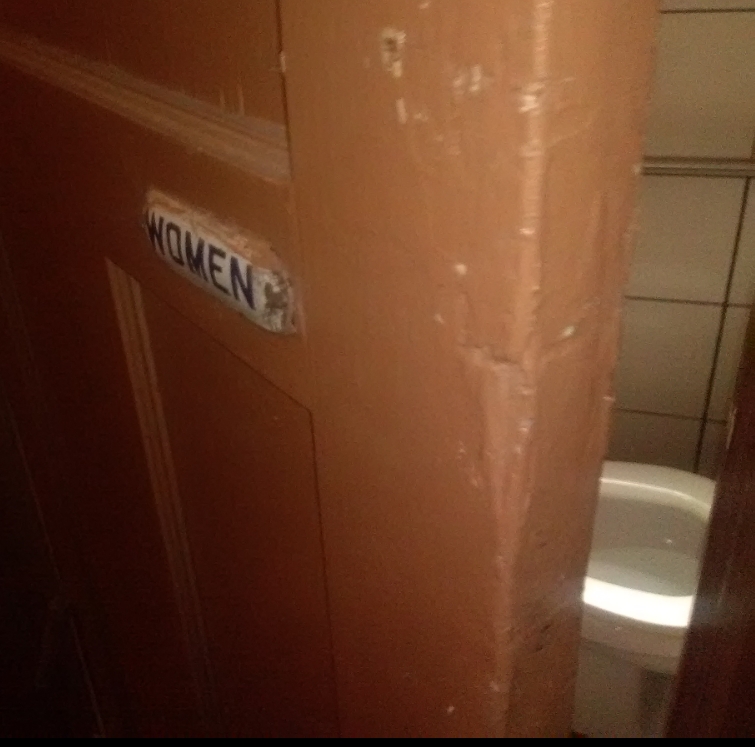
Enter the Del Bex Hotel, a privately run SRO at 2126 Mission Street. I was doing door-to-door outreach with Causa Justa/Just Cause, when I saw that some of the common bathrooms had the jankiest looking gender signs. I looked inside and saw that they were single-use bathrooms. Surreptitiously, I snapped some photos and reported the hotel to the DBI and sent the photos to Carolina Morales, an aide to then-Supervisor Hillary Ronen.
The DBI closed the report because the ordinance only covered places of public accommodation, not common bathrooms in SROs. That prompted Ronen’s office to take up legislation to close that loophole.
Around the same time, the Board of Supervisors considered me for a seat on the SRO Task Force, a city advisory body dealing with these issues. I was appointed in May 2017, and in my first meeting I mostly kept quiet and watched and learned as the commission discussed pending legislation prohibiting shower timers in SROs. When we got around to discussing future meeting topics, I said that since our next meeting was during Pride Month, we should discuss expanding the gender-neutral restroom ordinance to include SRO restrooms.
Rosemary Bosque, the task force chair, obliged, and it was placed on the June meeting’s agenda. That day, I dressed in trans colors and it felt really good to be able to have the trans community on the agenda. I spoke about my experience in my SRO, the fact that the Del Bex Hotel had gender-specific signage, and why this is important for the community. Sadly, no audio recording exists, but I do remember Matthew Luton from DBI presenting on how amending the building code is a process, but I reminded him that we had already identified a Supervisor as a sponsor and that we would go through whatever it needed to go through to make it come true. I then made a motion to send a letter to the Board of Supervisors in support. It passed 6-3, with Bruce Burge (landlord), Sam Patel (landlord) and Dan Jordan (tenant) voting against. I was elated, but still it felt like a Pyrrhic victory because any San Francisco government body in 2017 should be unanimous on trans rights.
The legislation underwent a nearly five-month long drafting process with the City Attorney’s office. As impatient I was, I managed to focus on bringing a true tenant-centered agenda to the task force. I graduated from the Mission SRO Collaborative’s leadership academy and was awarded the Volunteer of the Year at the Harvey Milk Club Gayla.
But by November, it was showtime, as the legislation finally came back, and I actually got to see it before Ronen, who introduced it at the Board of Supervisors on December 5. The legislation was under a 30-day rule, and would go before the Youth Commission, which approved it unanimously, the SRO Task Force—whose meeting I got to chair—the Building Inspection Commission, which also approved it unanimously, and then to the Board’s Land Use and Transportation Committee on January 29, 2018.
That was a beautiful day for the transgender community in San Francisco. While only a few people spoke during public comment, we had the right people getting behind the lectern, including two immigrant trans women I organized with in the Mission Collaborative, a Collaborative staffer, as well as representatives from the Youth Commission, the Mayor’s Office on Transgender Initiatives, Citizens United Against Violence, the Transgender Cultural District, Housing Rights Committee, Chinatown Community Development Center, SRO Families, and Senior & Disability Action, among others. Although I was a little miffed at Supervisor Ahsha Safa’i misgendering me, I was happy to see the committee pass it unanimously.
One week later at the full Board of Supervisors, Supervisor Malia Cohen gave a great speech about how gender neutral bathrooms have been a success and the world still keeps turning. The board passed the ordinance unanimously.
After that, I pitched an idea to Clair Farley of the Office of Transgender Initiatives: I proposed that Mayor Mark Farrell stage a signing ceremony and illuminate City Hall in trans colors. On the night of February 13, a few hours after its final passage and on the eve of a Valentine’s Day signing ceremony, City Hall was awash in light blue, pink and white. The next day was the signing ceremony, in which I got a pen from the mayor as he signed it into law. I remember it was also the birthday of one of Ronen’s interns, and the celebrations ended up merging as we went to her office.
At the SRO Task Force meeting the following day, task force chair Bosque brought in a copy of the Bay Area Reporter, which had the signing ceremony on Page One, and invited me to say a few words. I mostly said that I was glad this passed, so I could focus on nuts-and-bolts issues before leading a discussion on a less sexy topic: bed bugs. Later, I would once again report the Del Bex Hotel, which abated the bed bug issue on the first day of Pride Month, 2018.
I would serve on the SRO Task Force for another year and a half before it disbanded, but not before beginning to push through another big legislative project: bringing rents down to 30% of income in all permanent supportive housing with the #30RightNow campaign.
Eight years have passed, there have been many comings and goings, but this trans woman is still advocating for permanent supportive housing and SRO tenants. I hope one day my first legislative project becomes archaic, as everybody has their own gender-neutral restroom in their home. This is important as there are several permanent supportive housing sites with multi-stall common restrooms, which are exempt under this law. But until then, the law stands with pride.
Jordan Wasilewski (she/they) is a long-term permanent supportive housing and SRO tenant advocate, former commissioner and affordability activist. You may follow her at @sfpshsro on Instagram.