
by Jordan Wasilewski
In one of his corny anti-graffiti videos, Supervisor Bilal Mahmood talked about how he is all about the data. However, data can have many shortcomings and might not be able to tell the whole story, as we have seen with low-income people being evicted from housing that is supposed to help them stabilize.
I went to the Homelessness Oversight Committee’s October 1 meeting. In contrast with my paper-ripping theatrics at the previous meeting, my public comment was relatively more muted, yet I knew it had an impact: there was a deeper dive into evictions and all exits from permanent supportive housing in the Director’s Report. I do wish that it had been agendized as a separate item, because between the hearing on reprocurement (the reason most people were there) and the announcement of the troubled permanent supportive housing provider HomeRise’s phasing out operations, the airspace was clogged, so it didn’t get the attention it so richly deserved.
Still, I was glad that the meeting dedicated time to examine PSH exits. According to the data, approximately 9.3% of PSH tenants exited their households; of that, 4.1% were “exit by client choice,” 2.1% were eviction, 1.7% were “unit abandonment,” 0.9% were unknown, and 0.5% were “exit to institutional setting.”
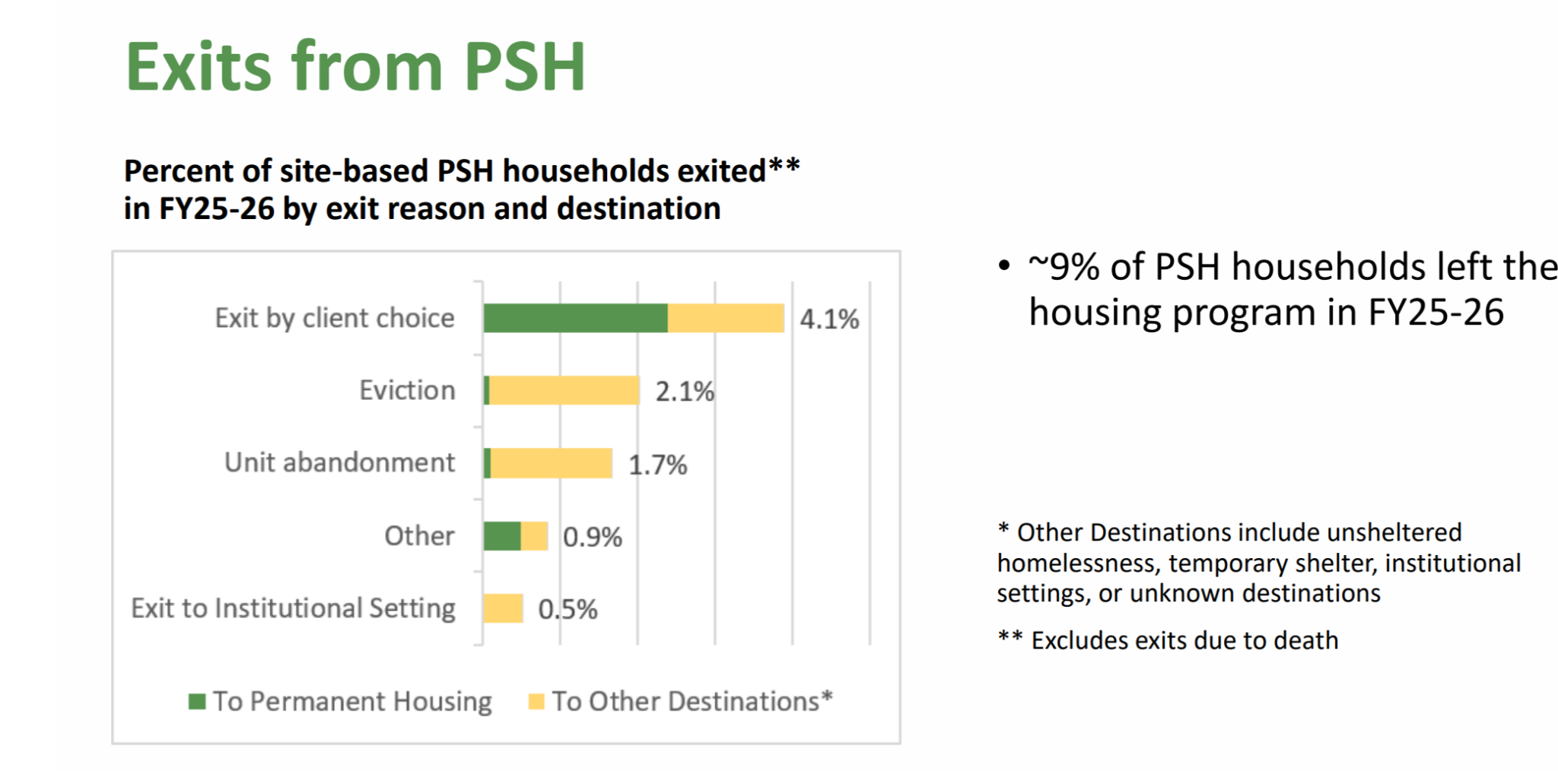
Source: Department of Homelessness and Supportive Housing, Director’s Report, October 2026.
Several of the data points were further separated by “to permanent housing” and “to other destinations.” While just a little over half of “exit by client choice” was “to permanent housing,” too many were to “other destinations.” Now, let’s do a little middle-school algebra here: The number of actual permanent supportive housing is a range between the number of recorded evictions at the low end, and the number of recorded evictions plus “client exited by choice to other destinations” at the high end, because a lot of tenants are pushed out of their housing through tools other than legal eviction. If Mahmood were truly concerned about the data, he would be collaborating with the Department of Homelessness and Supportive Housing and working on legislation that improves data collection on PSH evictions and exits, as required by City law.Further, the city needs to report data in real time, as the City had promised in 2023 during former Supervisor Dean Preston’s hearing on evictions.
Then, the presentation went into some good news and bad news. The good news is that 50% of PSH sites have had no legal evictions; the bad news, being nearly half of all legal evictions coming from 10% of sites. This means that HSH has an opportunity to focus on improving those sites and addressing tenants’ needs while balancing their autonomy with overall safety. There was also an associated bar graph of sites with more than 100 households active, identified only as A through Q in ascending order, ranging from A and B having no legal evictions, C through K having legal eviction rates that are lower than average, and L through Q having higher legal eviction rates than average, with Q topping out at 5.9%. I wish that the department would have identified the sites. In the last slide, there was a mention that eviction notices are down, but evictions are up.
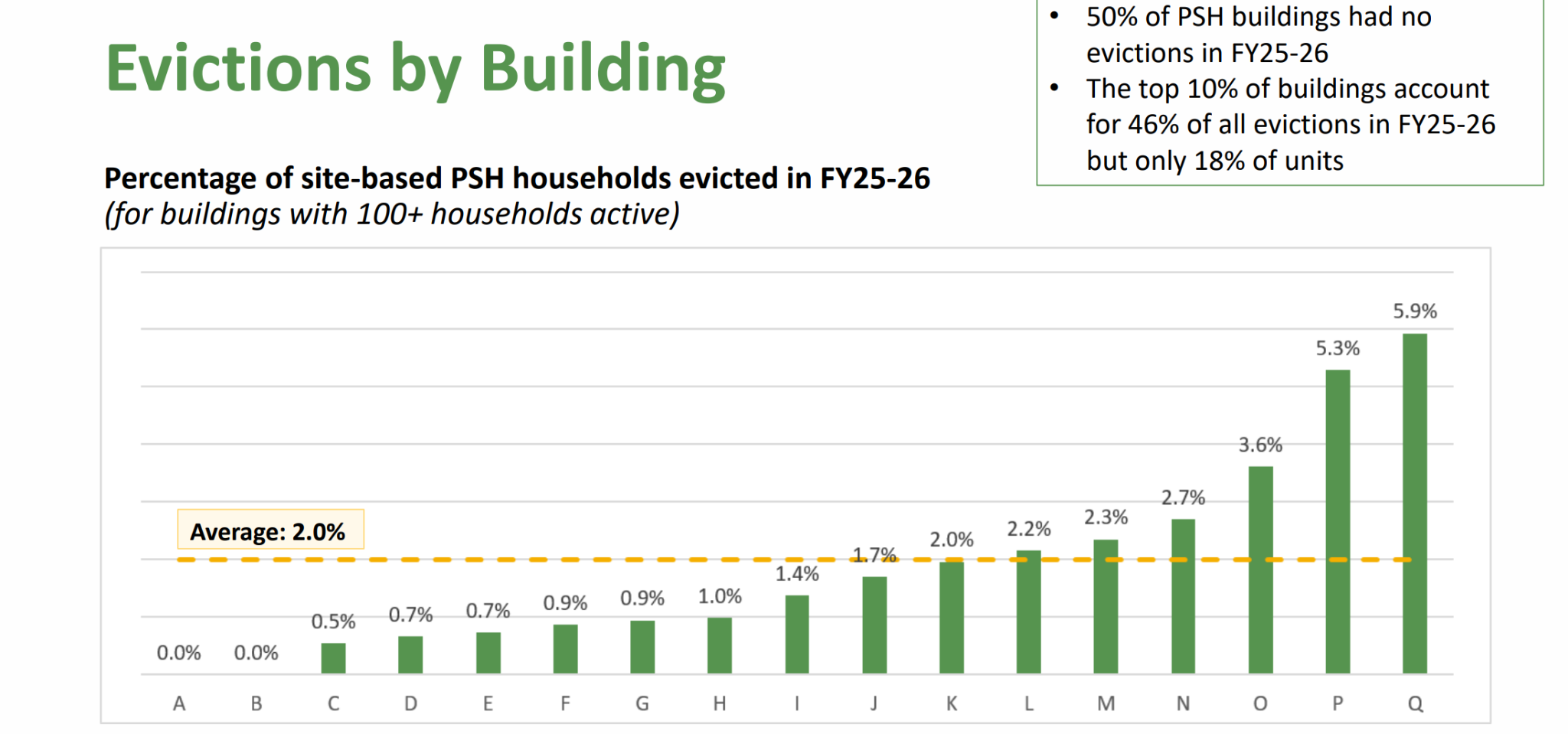
Source: Department of Homelessness and Supportive Housing, Director’s Report, October 2026.
Then, there was public comment, where two permanent supportive housing providers spoke on the issue. First was Lauren Hall from Delivering innovations in Supportive Housing., Her organization reports relatively low eviction rates, except for the Camelot Hotel which has had a high eviction rate for two years straight. I brought that fact to her attention. Hall shouted me down during her comment, saying that when she mentioned the Camelot and said that the Camelot’s high eviction rate was due to some acts of extreme violence. This indicates, again, that the data doesn’t tell the whole story, and that) the City is not providing enough support and adequate housing to tenants for them to be successful. Then, Tabitha Allen from the Tenderloin Housing Clinic, a frequent evictor, spoke about how they really want evictions to be a last resort and talked about checks and balances, which was touched on in the HSH Non-Payment Guidelines from 2023.
Of course, I am sure that many providers truly want evictions to be truly a last resort, but the road to hell is paved with good intentions. I know I might have a reputation of being reactive, but for this issue, I have spoken to multiple sources and stakeholders. If the Eviction Defense Collaborative, which has been overwhelmed by PSH evictions, is naming the Tenderloin Housing Clinic and others as notorious evictors, then the checks and balances aren’t checking and balancing. It’s time for the City to set parameters that are based on best practices. The PSH providers who have been identified as serial evictors all need to talk to the Eviction Defense Collaborative and be ready to hear constructive feedback on eviction prevention.
The success of the City needs to be judged by how it’s keeping our most vulnerable tenants housed and off the streets, contributing to a cleaner, more vibrant city. Mayor Daniel Lurie can never be able to say “let’s go, San Francisco” unless we are included. Our success as permanent supportive housing tenants is the city’s success.
Jordan Wasilewski (she/her) is a long-term permanent supportive housing and SRO tenant advocate, former commissioner, affordability activist, and good government girlie. You may follow her at @sfpshsro on Instagram.