
by Lupe Velez
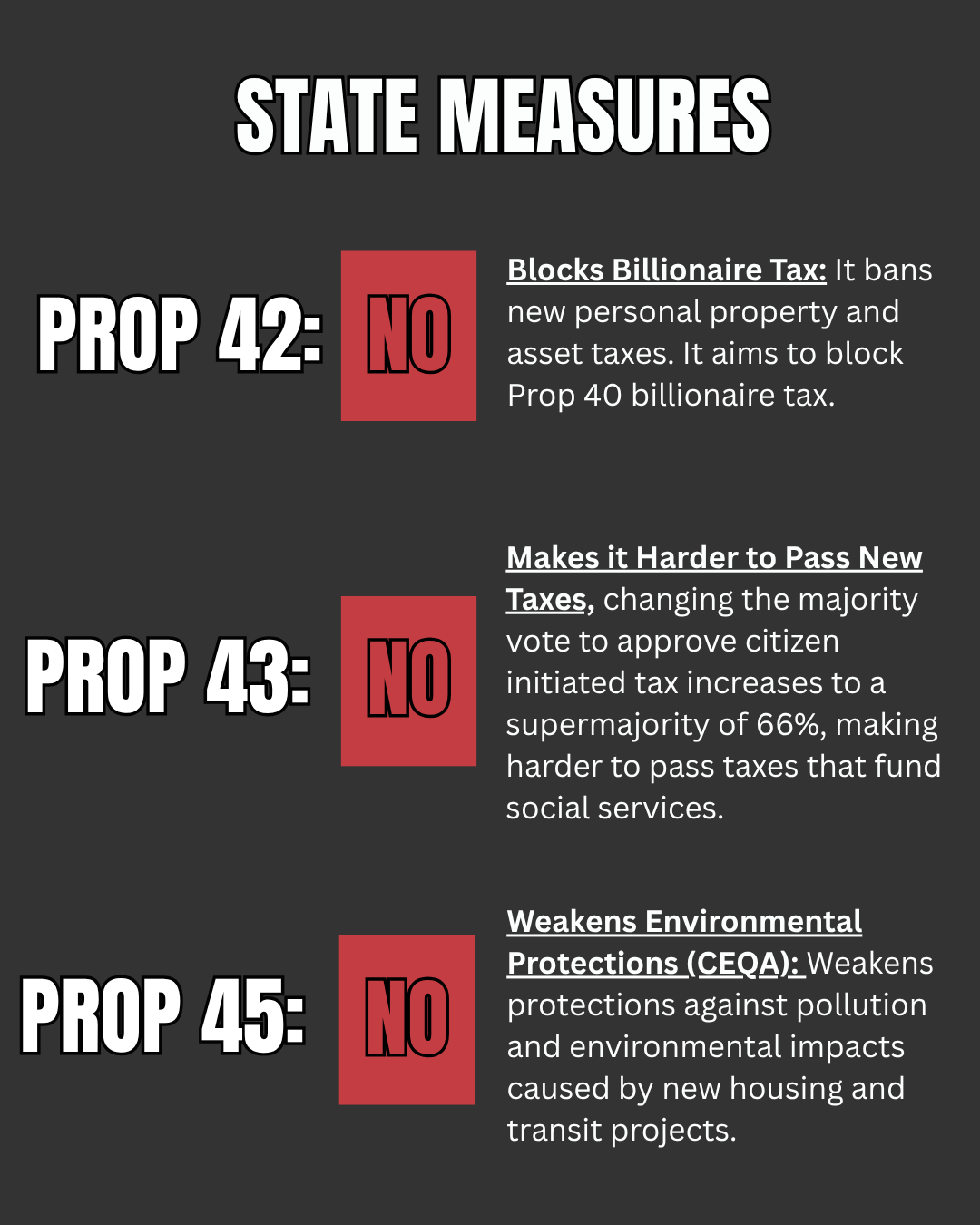
Proposition 43 on the November ballot for California voters would raise the required threshold for special taxes to pass from a simple majority of 50%+1 to a supermajority of two-thirds, or 66.67%. The Coalition on Homelessness and a number of groups and organizations including Evolve California, League of Women Voters of California, SEIU, Union of Educators and Classified Professionals, American Federation of Labor, the ACLU Southern California, as well Gov. Gavin Newsom and Mayor Daniel Lurie have been outspoken on how this measure would make it increasingly difficult for voter-led initiatives to pass special taxes could fund social services like education, transportation, homelessness, healthcare, etc. Revenue from special taxes could be especially crucial next year as California faces Trump Administration funding cuts.
To put this measure’s potential consequences into context, Prop. C, a tax on the gross receipts of large corporations that passed in 2018, would not have passed with a supermajority vote— it received only 61% approval. The measure was drafted and carried by the Coalition on Homelessness in conjunction with dozens of stakeholders who designed it based on homelessness trends and data, conversations with the unhoused population and evidence-based practices. San Francisco voters passed it to fund solutions to homelessness including housing, homelessness prevention, shelter and behavioral health treatment. Another local example from that same year was Prop. G, where San Francisco voters approved $62 million a year to raise teacher pay and keep teachers in the city’s public schools with 61% vote. People-led initiatives like Props. C and G would have failed had Prop. 43 been in place in 2018.
Large corporations have been attempting to stipulate a supermajority vote to avoid being taxed by voter-led initiatives for decades. The legal battle over stipulating a simple majority or supermajority for special taxes dates back to 1996, in which Prop. 218 mandated that local governments may only pass a special tax with a two-thirds majority. In 2017, the California Supreme Court ruled that this applied only to special taxes placed on the ballot by local governments, not citizen initiatives.
This brings us back to Prop. C. The Howard Jarvis Taxpayers Association sued on the grounds that Prop. C did not meet the two-thirds majority. But state appeals courts ruled that this threshold did not apply to Prop. C, citing the 2017 decision.
Fast forward to 2026: The Howard Jarvis Taxpayers Association, the proponents behind Prop. 43, are now attempting to undo that decision in a billionaire-backed campaign.
This November is our opportunity to fight the billionaire agenda at the ballot box, preserve our democracy and our right to allocate crucial funding for affordable housing, education, healthcare, the homelessness crisis, etc., from taxes on the very corporations that hoard the wealth! Vote No on Prop. 43!